
The “Please, Not Another Email” Effect

Your audience is tired.
Every day, they’re scrolling, clicking, reading, buying, signing up, logging in, checking notifications, and making thousands of little decisions about what is worth their attention.
Your marketing is somewhere in that mix.
While it’s often thrown around the internet that the average person sees around 4,000 to 10,000 ads per day, this claim isn’t actually backed up by reliable data. It does, however, draw attention to the fact that consumers are inundated with an enormous amount of messaging and information every single day.
After a while, ads get skipped, emails get deleted, forms get abandoned, and everything starts to blur together into one marketing-shaped blob.
That’s consumer fatigue. And for marketers, it’s a problem worth paying attention to.
When Your Audience Is Over It

So what exactly is consumer fatigue?
It’s the mental exhaustion, apathy, and detachment that comes from the sheer volume of information, marketing messages, hoops they have to jump through, and decisions coming at people from every direction.
And no, it’s not all coming from social media.
It’s also coming from:
Paid Ads (streaming, search, OOH, etc.)
Emails
Notifications
Promotions and sales
Subscriptions
Accounts and logins
Complicated purchasing processes
The 54 websites asking you to “accept cookies”
Individually, these things aren’t so bad. Collectively? It’s enough to make anyone check out.
Consumers start unsubscribing from email lists, ignoring notifications, and abandoning forms or processes that require too many steps. They start sticking with brands they already know and trust, or rely more heavily on reviews and recommendations when deciding where to spend their money.
It doesn’t mean they dislike your brand. They just don’t have the capacity to engage with every message you put in front of them.
In fact, some common marketing practices are making the problem even worse:
Too much content
More posts, more videos, more articles, more ads… you get the idea. The information overload only makes it harder for consumers to determine what’s actually worth stopping for, and when everything feels equally urgent, interesting, or important, it becomes a lot easier to tune it all out (yikes).
“Always selling” mentality
When every interaction ends with “Book a call” or “Buy now”, your audience starts to catch on. If every piece of content is trying to get something from them, they’ll eventually stop giving you their attention.
Excessive communication
Your audience probably doesn’t need three emails about the same offer, followed by a social post, a retargeting ad, and a reminder notification. There’s nothing wrong with using multiple channels to reinforce a message, but it needs to be done strategically. Vary the messaging, timing, and format to avoid becoming overly repetitive and so your audience doesn’t see the exact same thing everywhere they turn.
Lack of brand differentiation
Brands are using the same formats, aesthetics, trends, and talking points. When everyone’s messaging looks the same, why would anyone stop for yours? When your audience keeps seeing the same thing from every brand they encounter, it becomes harder to stay interested in any of it.
Generic personalization
Putting someone’s name in an email isn’t exactly groundbreaking or meaningful.
If it feels like it could be sent to anyone, we hate to break it to you, but it’s not doing any heavy lifting. It just means you know someone’s name.
Personalization is a great way to make your marketing feel more relevant, but when it’s too surface-level, there might as well be no personalization at all. Want to make it actually personal? Keep reading.
Friction
An unnecessarily lengthy process just adds to consumer fatigue. With every extra step, click, or decision that needs to be made, you are pushing your audience one step closer towards an “actually, never mind”.
How to Keep Your Marketing Out of the “Mute” List

So, how do you reach your audience without becoming another one of those brands they automatically ignore or mute?
It starts with making your marketing more relevant, valuable, and intentional. When your audience is already dealing with consumer fatigue, every interaction has to earn its place in their attention.
Here’s how you make sure your brand doesn’t end up on their “mute” list:
1. Audit how your brand shows up
Audit your marketing across social, email, website, paid advertising, and other brand communications. Look at the frequency, calls to action, messaging, and how everything works together.
How do your channels overlap? What does the full customer journey actually feel like?
On their own, one email might be perfectly reasonable. One social post is reasonable. One OOH ad is reasonable. But when someone sees all three in one day? Suddenly your brand is giving needy ex that just won’t take a hint.
Look at the experience as a whole and figure out where to trim the fat. Not sure where to start? A marketing audit can help you spot what’s unnecessary and what’s actually worth keeping.
2. Give people a reason to notice you
Differentiation matters when everyone is fighting for attention.
Have a unique point of view, show some personality, and say things your competitors aren’t. Give your audience something they can actually associate with your brand.
Because what value are you adding by creating the same generic “5 Ways to Improve Your Business” carousel? Your audience has seen it before, they don’t need to see it again.
3. Make personalization actually personal
Too often, brands confuse personalization with simply adding someone’s name to a newsletter.
Real personalization goes beyond that. It considers who you’re actually talking to and uses that information to make their experience more relevant.
Think about their:
Interests
Behaviour
Past purchases
Browsing activity
Content engagement
Previous interactions
Customer lifecycle stage
Stated preferences
Good personalization should make your audience think “wow, they actually get me” and not “wow, they know my name”.
4. Give people something worth their attention
Not every interaction needs to end in a sale.
Sometimes the best thing you can do is teach something useful, answer a question, make a process easier, or simply entertain them. Engagement doesn’t have to be centred around your audience pulling out their wallet.
This is especially important when it comes to consumer fatigue. Every interaction is asking for some level of attention. Make sure there is at least something on the other side of that ask.
5. Meet your audience where they are
Know where your audience is in their customer journey and make sure your marketing matches. Segment your audience based on their level of awareness, interest, and interactions with your brand, then tailor your messaging so it’s relevant to them.
For example, don’t serve a cold audience a hard-sell, lower-funnel ad when they’ve never even heard of you. In the early stages, focus on introducing your brand and giving them a reason to stick around. Upper funnel content doesn’t need to scream “THIS IS AN AD”. It should be useful, entertaining, or genuinely interesting content that earns attention on its own. Ideally, it should feel less like an ad and more like an organic post they’d naturally engage with.
Give your audience the right message at the right time instead of giving everyone the same pitch and hoping something sticks.
6. Keep your paid ads moving
If someone sees the same ad 10 times, they aren’t going to become 10x more interested… they’re probably going to mute you.
Regularly rotate your creative, copy, hooks, angles, and formats. You don’t need a shiny new campaign every week, but continue to give your audience reasons to pay attention instead of repeating the same message over and over.
Use frequency caps and suppression rules to limit unnecessary exposure and keep your advertising relevant. For example:
Stop promoting a product after someone purchases it
Exclude converted leads from specific campaigns
Adjust messaging based on where someone is located in the customer journey
7. Focus on quality, not quantity
Before hitting publish on that social media post, ask yourself: does this actually add value?
Your audience already has enough to look at, read, watch, click, etc. Adding an unnecessary social post or an extra email, just because there’s a blank space in your content calendar, isn’t going to have the impact you’re hoping for.
Consumer fatigue doesn’t mean you ghost everyone. It means you need to be more selective about what earns your audience’s attention.
Sometimes, the best thing you can do for your marketing, is to not push send.
Before You Hit Send…

When it comes down to it, consumer fatigue is an attention problem. Your audience only has so much time, energy, and patience before the constant stream of information and decisions starts to feel like a lot.
So before you go add another piece of content to the mix, take a second to ask yourself: does this actually deserve their attention?
Instead of thinking:
More content → More valuable content
More personalization → More relevant personalization
More reach → Better engagement
More ctas → One clear next step
More communication → More intentional communication
Then give your next campaign, email, or social post a quick check:
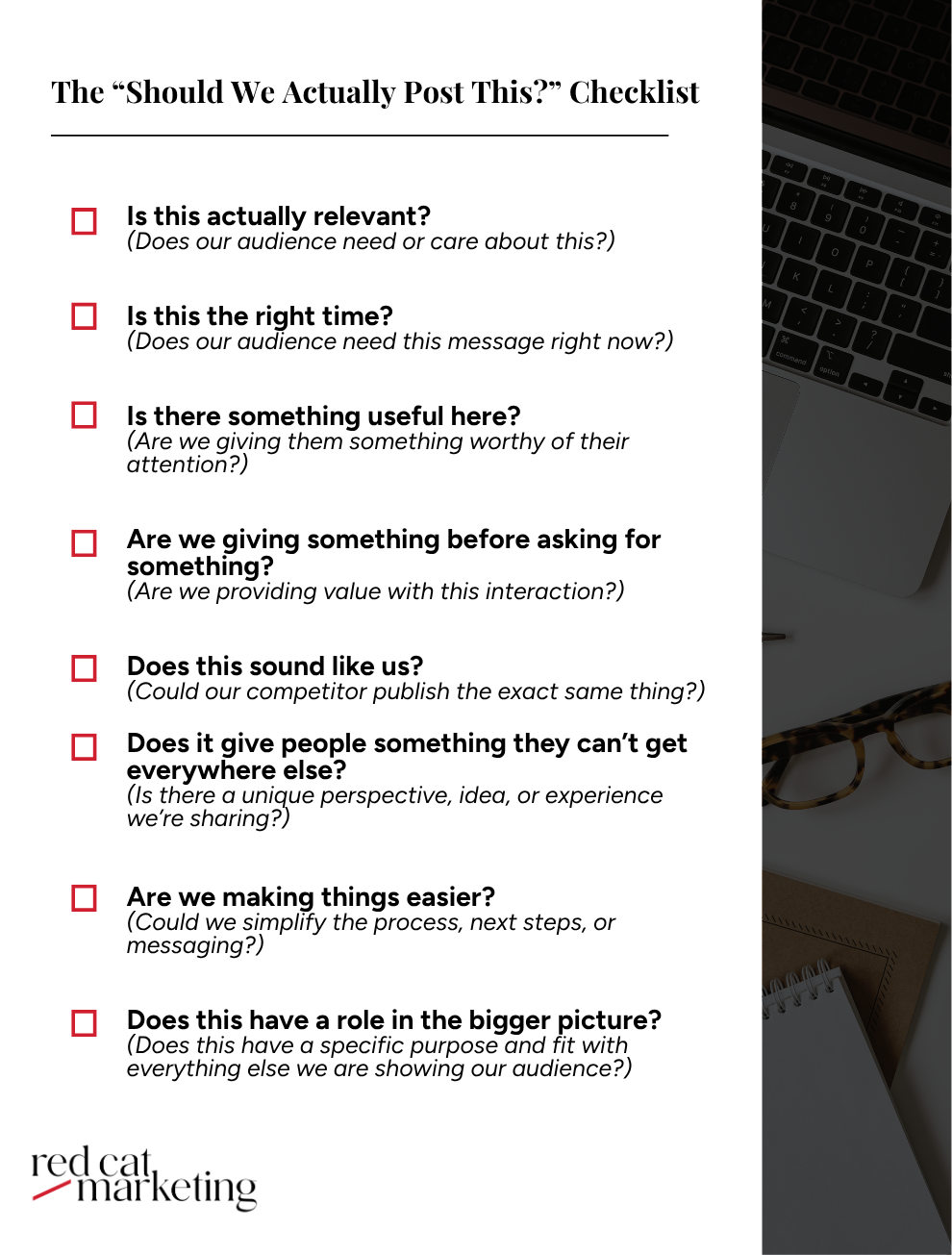
Consumer fatigue is here to stay. There will always be a wave of more brands, more content, and more things competing for a piece of your audience’s attention. That’s out of your control.
What you can control is whether your marketing adds to this fatigue or gives your audience a reason to stop and pay attention. Make every interaction count, give people something worth engaging with, and create an experience that won’t allow your audience to tune out.
Your audience might already be overwhelmed, but give them a reason to choose you anyway.
Ready to stop adding to the marketing overwhelm? Let’s chat and see how we can make your marketing more relevant, valuable, and worth your audience’s attention.