

Remember when getting discovered online meant showing up on Google? Good times. Now the game has changed and we’re not only trying to get our audience to notice us, but we’re also trying to get robots to notice us. Great.
With platforms like ChatGPT and Claude changing how people search for information, compare options, and make purchasing decisions, AI visibility has become another piece in the marketing jigsaw puzzle to figure out. Since AI is always evolving, what works today might look different tomorrow. You need to stay on top of what’s happening, what’s changing, and what’s actually relevant in the moment.
So, where does AI visibility stand right now, why should brands care, and what can you actually do about it? Let’s get into it.
What is AI Visibility and Why Should Brands Even Care?

Unless you’ve been living under a rock, you’ve definitely heard about AI. But for many, the question is: What actually is AI? And why should you even care?
AI visibility is how easily AI platforms can find, understand, and reference your business and content when generating answers and recommendations.
Think of someone asking Claude to recommend a building maintenance provider in Toronto or to find an HR company that offers fractional support. You’re going to want your business to be one of the options AI lists when someone is looking for exactly what you do.
This matters because the way people discover businesses is changing. While search engines are still very much in the picture (we love you, Google), potential customers might skip the search results altogether and opt for a route that requires slightly less brain power. From AI platforms to AI search overviews, these tools have become a bigger part of search.
In fact, studies have shown that visits to generative AI platforms worldwide have grown 70% year over year, reaching 9.5 billion visits per month on average. That’s a lot of people using AI tools to discover new options, analyze information, and get recommendations.
If your business isn’t showing up in relevant AI-generated answers, you could be missing opportunities to get in front of potential customers.
Traditional Search vs. AI Visibility: What’s the Difference?
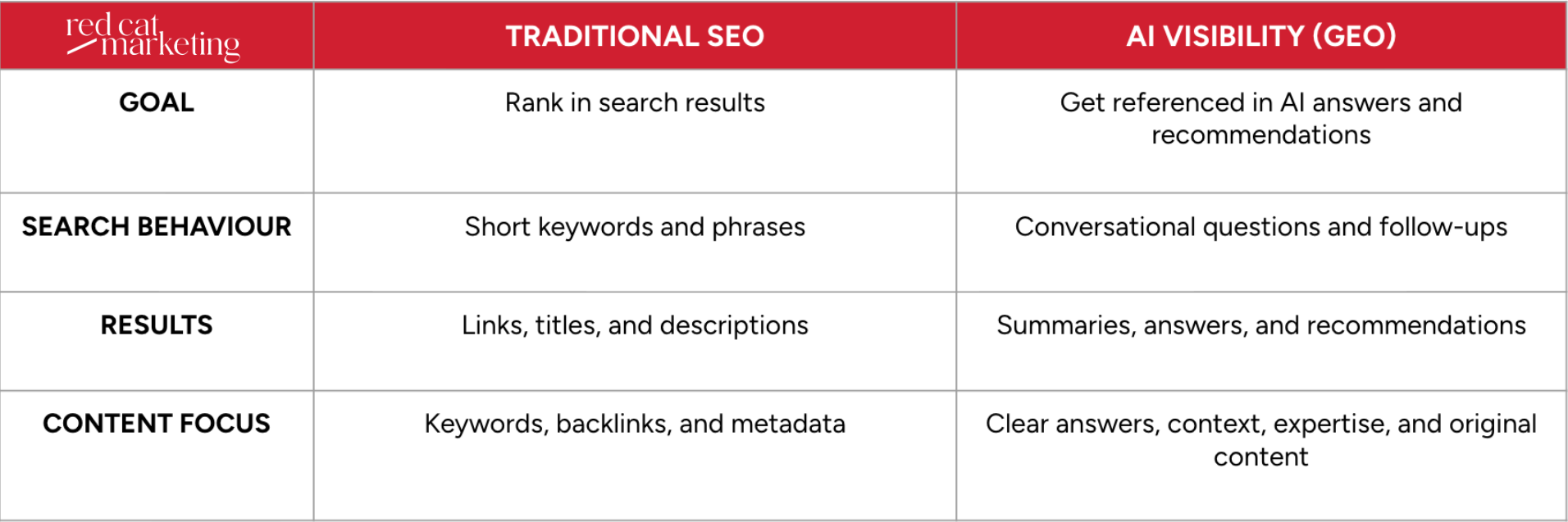
SEO helps people find your website in the search results. GEO, or generative engine optimization, focuses on helping your brand and content to get discovered through AI-generated answers.
Before you jump on the AI bandwagon and leave poor SEO in the dust, remember that GEO isn’t replacing SEO. It’s building on it. A well-structured website with original, useful content earns a thumbs up from both, but you still need SEO fundamentals. Now you also need to consider how your content is going to be interpreted and referred to in AI-generated answers.
What Really Influences AI Visibility?

With AI constantly changing, new platforms with different systems and methods popping up left, right, and centre, it’s hard to find a universal checklist that will 100% guarantee AI visibility to all platforms.
Visibility is more like a long game. You need to be constantly staying on top of what’s happening and what’s relevant in the moment.
So without further ado, here’s what impacts your AI visibility at this very moment.
Right now.
Like, right this second.
THIS is where we are with AI visibility.
Authority
AI platforms will only pull from credible and reliable sources.
When your business is mentioned by respected third-party sources, it gives AI more context about your business, proof that you are a legitimate authority in your industry. These mentions signal that your business is credible and trustworthy, making AI more confident in recommending you to relevant searchers. After all, a relevant mention from an industry source carries more weight than a random link from a website that has nothing to do with your business.
Think industry publications, news articles, podcast appearances, interviews, partnerships, and backlinks. The goal is to collect relevant and credible links, not collect as many links as possible.
Original Content
If your website is just regurgitating the same basic advice as everyone else, there’s nothing to distinguish you from competitors or make your site stand out to potential customers.
Original content gives people a reason to not only visit your site in the first place, but to stay on your site, engage, and even visit again. Share your experience, explain your approach, publish useful research, share your industry insights or opinions.
The goal is to create useful content your audience can’t get anywhere else. It needs to provide value and be backed by real facts so it’s worth referencing in AI conversations.
Technical Accessibility
Your website needs to be accessible to the systems trying to discover and interpret it.
Clear headings, logical page structures, descriptive links, internal linking, and overall well-organized content is what is going to help these systems establish context for your business and understand what it is exactly that you do. All important information should be readable to AI, not presented in formats that are difficult to interpret. For example, text in an image without alt text to tell AI what the image is actually about or improperly structured accordion content that isn’t included in the page’s HTML.
A clear relationship between your content will help establish topical relevance and signal what your content is really about. Good technical SEO will support your AI visibility, so don’t forget the basics.
Clear Positioning
If someone lands on your website, could they quickly figure out what you do, who you work with, where you operate, and what makes you different from competitors?
If the answer is no, you’ve got some work to do.
Vague positioning makes it harder for potential customers and AI platforms to find you. Clear descriptions of your services, audience, location, and expertise will provide AI with context about your business and help establish where it can recommend you.
Consistency
Your website says one thing. Your Google Business Profile says another. Your LinkedIn page hasn’t been updated in months. What third parties are saying about you doesn’t match what you’re saying about yourself. What a mess.
Inconsistent information makes it harder to establish a reliable picture of your business. Your name, services, locations, expertise, and positioning should remain consistent across your website and all other platforms.
We’re not saying it has to be word-for-word the same, but the facts and messaging behind your brand should remain consistent no matter where you are.
How to Improve Your AI Visibility Right Now

So what can marketers actually do? Start with these eight practical steps.
1. Get Clear on Who You Are
Review your homepage, services page, about page, and any other key content on your website.
Make sure each page is clearly communicating what exactly your business does, who you serve, where you operate, and why customers should choose you.
Be very specific. If your target audience is specifically startups, not just small businesses, say so. If you only serve customers across a specific geographic area, make it very clear.
2. Update Your Information
Outdated information is not doing you any favours when it comes to AI visibility.
Check your website, Google Business Profile, and social channels for old information like discontinued services, outdated pricing, and incorrect contact details and addresses. Yes, it's finally time to remove that team photo featuring half a team that doesn’t work there anymore.
If your business has changed, it's crucial that your digital presence reflects that. You don’t need to rewrite your entire website every month, but you should be regularly reviewing important details and updating content that is no longer relevant.
3. Audit Your Brand Across Platforms
Take a good look at your website, social media, industry directories, Google Business profile, and other relevant listings.
Are your services being described consistently? Is your address correct? Are third parties representing your brand accurately?
Pay attention to what others are saying about your business too. When you spot something inaccurate, correct it where possible, but make sure your own information is clear and reliable.
4. Answer the Questions Your Customers Actually Ask
Your audience likely has a ton of questions. Make sure you’re providing them the most value possible and answer them.
Think about what you’re asked on a regular basis, common objections you’ve heard, and key information your customers need before making a decision. Turn those points into useful blog posts, FAQs, and practical resources.
Use descriptive headings and direct explanations so readers can quickly find the answers they’re looking for. This also makes your content easier for AI systems to interpret and reference.
5. Build Authority Beyond Your Website
Your website is a key part of your online presence, but it’s not the whole picture. You can tell everyone how great you are, but it means a lot more when someone else backs it up (and no, your mom’s 5 star review doesn’t count).
Look for opportunities to establish authority and expertise in your industry. That means looking for opportunities like podcasts, interviews, published articles, or even industry collaborations.
A mention from a trusted, relevant third-party source carries a lot more weight in establishing your reputation and your AI visibility far more than a random link.
6. Make Your Website Easy to Read and Navigate
Before giving your website an entire AI facelift, check the basics first:
Clear Headings: Use descriptive headings that accurately describe what that section is about.
Plain Language: Avoid vague or highly technical language. Keep it simple when explaining what you do and who you help.
Related Content: Use internal links to connect relevant topics on your website and create an easy to follow map for AI crawlers.
Technical Accessibility: Make sure important content can be read and understood by AI by keeping essential information accessible on each page. Review design choices, indexing settings, and other obstacles that could be hiding your content from AI crawlers.
Logical Structure: Give each page a distinct focus, making it easy for AI to understand how it relates to the rest of your website.
No dramatic overhaul required.
7. Publish Content Worth Referencing
Create original content that showcases your expertise. This could look like detailed blog posts, case studies, research, or insights based on your experience.
Publishing content consistently can help you build a bigger library of relevant information that AI can pull from. But quality matters more than quantity. Don’t go on a posting rampage just to keep things fresh.
Focus on creating content that answers real questions, provides useful information, and gives people a reason to trust your business.
8. Test Whether AI Can Find You
You’ll never know unless you try!
Open Claude, ChatGPT, or another AI platform and ask questions your target audience would realistically ask. Test everything ranging from broad service recommendations to specific questions about your expertise or location.
Check whether your business appears, whether the information is correct, and which sources AI has pulled this information from.
One successful recommendation doesn’t suddenly mean you’ve cracked the code and can stop trying. Just like missing one recommendation doesn’t mean your strategy has failed. Results can vary as many factors, including platform, wording of your question, and location, can have an impact on the AI-generated response.
Repeat the tests over time and use what you learn to identify any gaps in your content, positioning, and your overall online presence.
AI has now become a crucial part of how businesses get discovered, evaluated, and considered by potential customers. The fundamentals are still the same: be clear about your offer, publish relevant original content, highlight your expertise, keep your information accurate, and make your website easy to access.
The difference is the way that people are discovering and consuming information. There’s more to AI visibility than the basics, so as AI continues to evolve, make sure your marketing strategy is evolving with it.
Want to know where your brand stands? Get in touch for an AI Visibility Audit to score where you (and your competitors!) are, and uncover opportunities to improve your chances of being noticed and recommended by AI.